
On 25 July 2024 the United States and the Republic of Cyprus signed a bilateral agreement under the auspices of the Proliferation Security Initiative (PSI). The PSI is a response by the United States, announced by President Bush in May 2003, to address "increasingly aggressive efforts by [weapons of mass destruction] proliferators to circumvent existing nonproliferation norms, and to profit from such trade."[1] The PSI's objectives include utilizing "existing national and international legal authorities" while strengthening "these authorities to meet today's WMD proliferation challenges."[2] The PSI is based upon a number of interdiction principles, which include:
- undertaking effective measures for interdicting the transport of WMD and related materials;
- adopting procedures for rapid information exchange;
- strengthening national and international legal authorities and frameworks;
- boarding and searching suspect vessels flying a State's respective flag;
- consenting to the boarding and searching of flag vessels by other States; and
- requiring suspect aircraft in a State's airspace to land for inspection and seize any WMD cargoes.[3]
Entitled as an "Agreement Between the Government of the United States of America and the Government of the Republic of Cyprus Concerning Cooperation to Suppress the Proliferation of Weapons of Mass Destruction, Their Delivery Systems, and Related Materials By Sea," the Agreement addresses the boarding and searching of flag vessels interdiction principle. The U.S.-Cyprus Agreement is the fifth ship boarding agreement the U.S. has signed under the auspices of the PSI. Similar agreements have been reached with Croatia, Panama, the Marshall Islands, and Liberia.
Specifically, the Agreement provides authority to "Security Force Officials" of either State to board suspect vessels of the other State in international waters after confirmation of the vessel and authorization to board is made by the non-boarding State.[4]. A vessel is determined "suspect" if "sufficiently reliable information forming the basis for the suspicion" exists and is included in the authorization request. This authorization includes the ability to detain the vessels, cargo, and persons on board "if evidence of proliferation is found," which is defined as nuclear, chemical, biological and radiological weapons or their delivery materials.[5] The treaty also stipulates that all uses of force "shall be in strict accordance with the applicable laws and policies of the Party conducting the boarding and with applicable international law."
According to the U.S. Department of State, the five bilateral PSI ship boarding agreements account for more than sixty percent of "the global commercial shipping fleet dead weight tonnage."[6]
[1] U.S. Dep't of State, Bureau of Public Affairs, Combating Proliferation: Proliferation Security Initiative 11 (2003).
[2] Id. See, e.g., Convention on the Physical Protection of Nuclear Material, Feb. 23, 1987, 1456 U.N.T.S. 101 (including recent amendments including nuclear facilities).
[3] Id.
[4] Agreement Between the Government of the United States of America and the Government of the Republic of Cyprus Concerning Cooperation to Suppress the Proliferation of Weapons of Mass Destruction, Their Delivery Systems, and Related Materials By Sea, July 25, 2005, U.S.-Cyprus, art. 4.
[5] Id at art. 1, 4.
[6] U.S. Dep't of State, The United States and the Republic of Cyprus Proliferation Security Initiative Ship Boarding Agreement, July 2005.
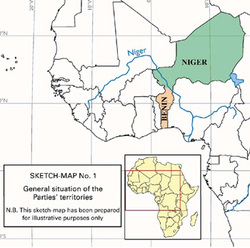 On Tuesday, 12 July 2005, the International Court of Justice (ICJ) announced its decision in the Frontier Dispute (Benin/Niger) case. This long-standing dispute between the West African States of the Republic of Benin (formerly known as the Republic of Dahomey) and the Republic of Niger concerns the entire territorial boundary between to the two States. The ICJ received the case, which the parties submitted jointly, on 3 May 2002. The ICJ's principal task in the case was to determine the definitive delimitation of the whole boundary between Benin and Niger. Sketch-Map No.1, from the ICJ's decision, illustrates the location of both Benin and Niger in West Africa (click on image for detailed view).[1]
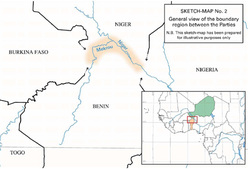 Historically, the frontier dispute between Benin and Niger dates back to the "accession to independence of the territories that were formerly part of French West Africa...." Both Benin and Niger became independent States in August 1960. A long unresolved matter, two Dahomey-Niger joint commissions met in 1961 and 1962, seeking a friendly settlement of their dispute. A focal point of the Parties disagreement focused on the island of Lété, and both parties agreed in 1965 that nationals of both States could inhabit the island until resolution of the frontier dispute. Further attempts to resolve the dispute occurred from 1995-2000, including six meetings of a joint commission created in April 1994. These efforts also failed to produce a negotiated solution. This commission, however, did suggest bringing "the dispute before the International Court of Justice by Special Agreement."[4]
